Biofeedback Training
Harnessing brain plasticity to enhance your vision
Biofeedback training uses the brain's natural ability to adapt, called neuroplasticity, to help patients use their eyes more effectively and improve the sharpness of what they see.
During training, a microperimeter links visual and auditory cues to guide eye movements. While focusing on a target, beeps help the brain learn how to align the most functional part of the retina with the object, face, or text the patient wants to see more clearly.
Patients with the following conditions can be treated with biofeedback training on the MP3:
- Hemianopia post-brain injury (stroke, tumors, trauma, and others)
- Macular Degeneration
- High Myopia
- Retinal Dystrophies
- Stargardt's Disease
- Retinitis Pigmentosa
- Nystagmus
- Other low vision patients
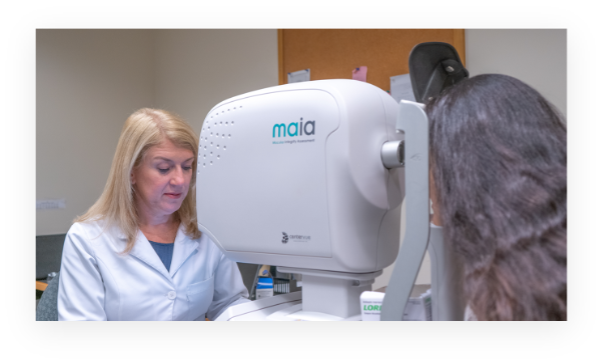
Simple, safe sessions
Most patients notice some improvement, typically 1 to 3 lines on the vision chart, after five to eight sessions of 20 minutes each.
This technology can also treat children and patients with nystagmus, with no side effects and practical benefits for reading, recognizing faces, and navigating environments.
Biofeedback Training for the Vision
Dr. Daibert Nido explains all about Neuro Vision Rehabilitation
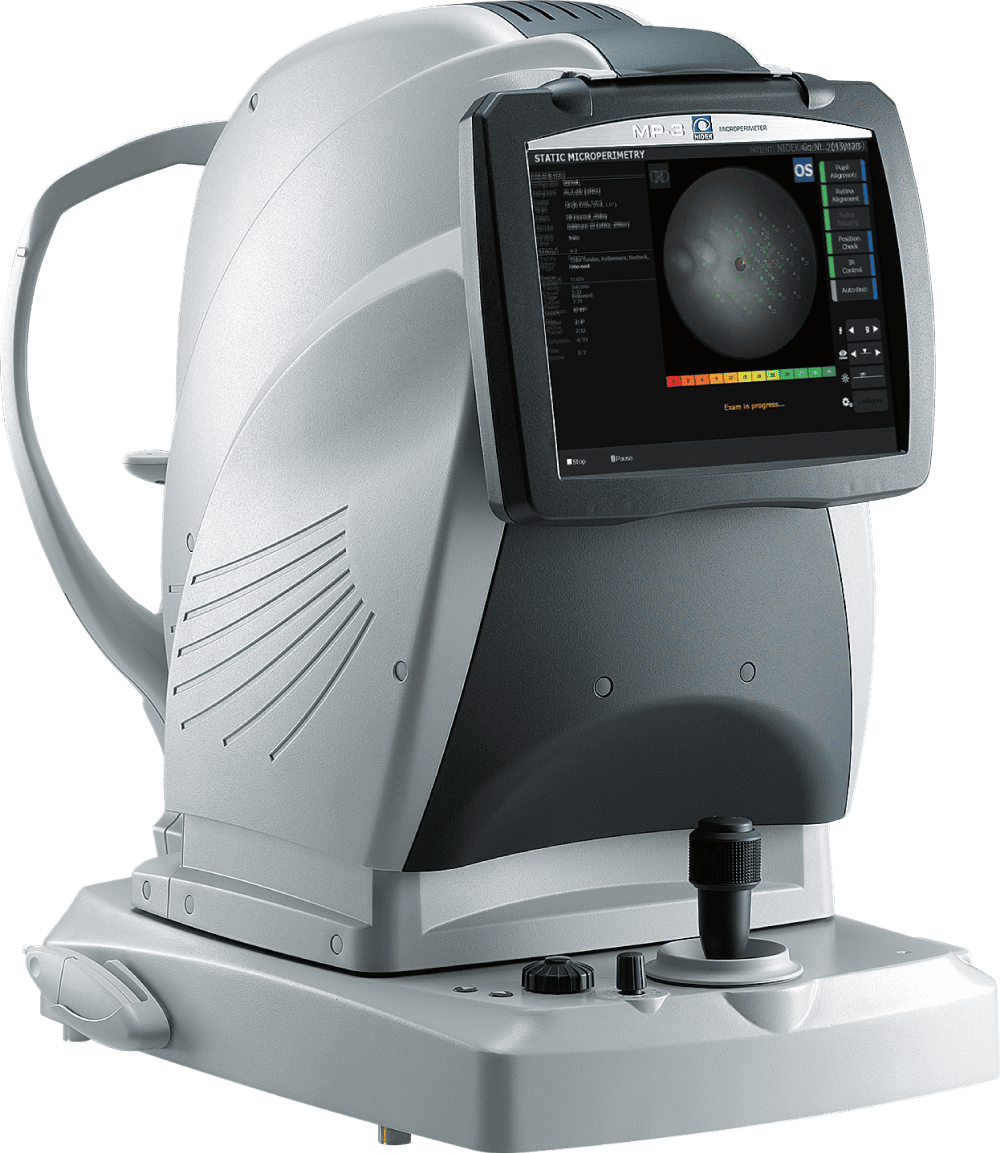
Modern MP3 Nidek Microperimeter
Novel biofeedback training with the MP3 device
The office in North York has the MP3 device that stimulates the brain's visual cortex with a flickering checkerboard and piano music. This has shown to be superior than the conventional technique, and has given better results in Dr. Daibert Nido treated patients.
A scientific research showed that this device is superior to the conventional biofeedback:
Amore FM, Paliotta S, Silvestri V, Piscopo P, Turco S, Reibaldi A. Biofeedback stimulation in patients with age-related macular degeneration: comparison between 2 different methods. Can. J. Ophthalmol. 2013;48(5):431-437. doi:10.1016/j.jcjo.2013.07.017.
See a real example of training on the MP3 with biofeedback training for nystagmus. The patient is encouraged to produce a continuous song by voluntarily controlling the eye movements and improves across the sessions.
This service is covered by OHIP.